Trans-Mongolian Journey: from Ulaan Baatar to Beijing
We woke to new scenery. After a day of the Gobi (like all deserts seen from a train, beautiful at first, and stultifying after seven hours of exactly the same), the small but jagged peaks of China were a welcome change. When I first raised the train curtain, I caught sight of windmills, not unlike the ones on Altamont Pass or off the 10 as you head from LA to Palm Springs, turning at the top of the low peaks.
Then, small gorges and hills with a terraced formation – natural or in the service of agriculture, I didn’t know. On one side of the train, there was evident agriculture, on the other, this. Trees dotted the landscape on that side in a way that seemed to be a pattern designed to appear haphazard. I could not tell what of this landscape was natural and what was engineered.
As we drew closer to Beijing, we first passed small towns built as I imagined a historical China – low-lying mud and brick walls; farmers pulling in the wheat stalks and burning fields; bright orange objects lying out in large piles, on rooftops and in bags. I wondered if they were mangoes waiting to be shipped to market.
Then, paved roads, evidently constructed retainer walls, and oodles of power lines. The sky grew shiny grey, as if clouded by forest fire, but likely just clouded by the spreading haze of Beijing pollution (the guidebook estimates that breathing Beijing air is the equivalent of smoking 70 cigarettes a day). We passed some power plant buildings like those in The Simpsons.
The first stop in China had been at midnight the night before, after passport control at the border (after the customs agent, bothered that we had nothing to declare, asked to see the book I was reading – “The Godfather” – and eyed it suspiciously). At that first stop, we disembarked and filed into the one market open in the Erlian train station.
This store, though small, was not unlike walking into the 99 Ranch Market – weird and wonderful products filled the shelves; there were baskets and baskets of indecipherable hard candies, including the perennial favorite, White Rabbit; the beer was fifty cents a bottle (and tasted, I would find out, like fifty cent beer).
I bought a clear drink in a glass bottle. It appeared to be a lychee drink, judging by the picture on the outside and by the floating chunks of gelatinous matter on the inside.
Like many weird and wonderful objects one buys at 99 Ranch just out of fascination, it’s a total crapshoot. I lost on this one – the drink tasted more like aspartame than fruit.
Eventually, we all drifted to sleep and slept the fitful but not bad sleep one grows accustomed to on trains. In the morning we drank coffee and ate oranges and watched the scenery go from empty to urban.
In a big fuck you to the initial and hopeful wind turbines, the rest of the journey was crowded with monstrous mounds of coal stored in shipping containers and open pits along the tracks, the convex stacks of nuclear power, and always in the distance the thin, red and white striped chutes so common to the old Soviet skylines.
Rows and rows of new apartment complexes, surrounded by wheat fields and this power generation, grew from a grey ground.
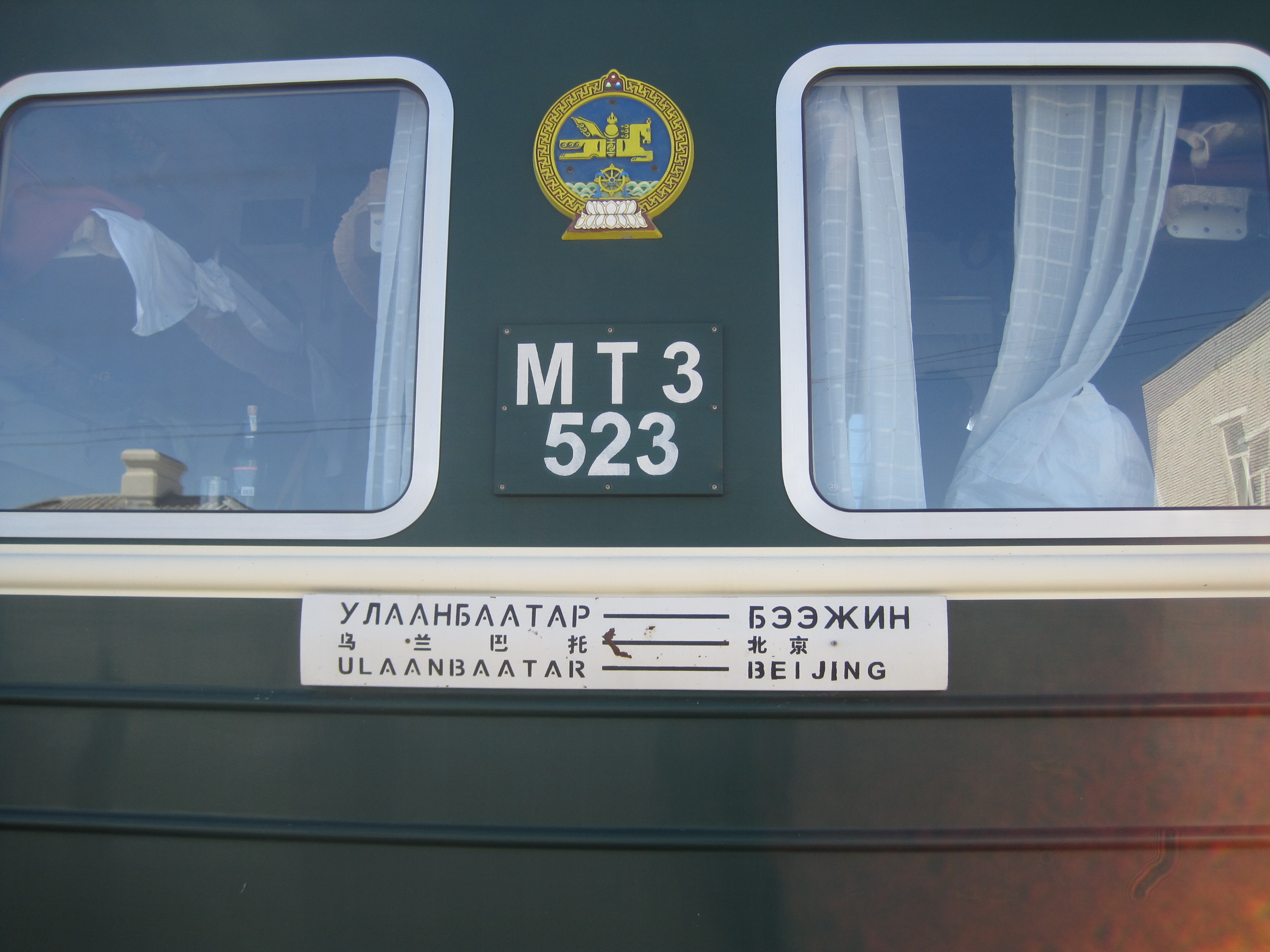
The day before, somewhere in Mongolia, I asked a fellow train passenger to snap a picture of me in front of the “Ulaan Baatar – Beijing” sign on the side of the train. Most of the journey so far had felt lackluster, but at that moment, I had nearly cried and also I could not restrain my grin. I was near the end of this train trip that had once seemed mythic, but now felt almost mundane.
But this morning, the familiarity of the train becomes nostalgic. It is the same feeling I have each time the train is about to arrive: I have become comfortable in my compartment, and I am anxious to venture forth into a new city, where the public transit is unfamiliar and the language unintelligible.
It’s a bittersweet feel. The train has been better to me at times than the cities it has stopped in. And it has forced me to keep moving; to not stay too long, and to not become too comfortable or too uncomfortable in any one place.
China awaits – with its spicy food, giant architecture and teeming metropolises. With its vastly different government, its lack of Google and Facebook, and its ancient dynasties. I have no idea what to make of it, but I’m strangely excited.