Adventure to Lake Baikal’s Olkhon Island (and a really cute kitten)
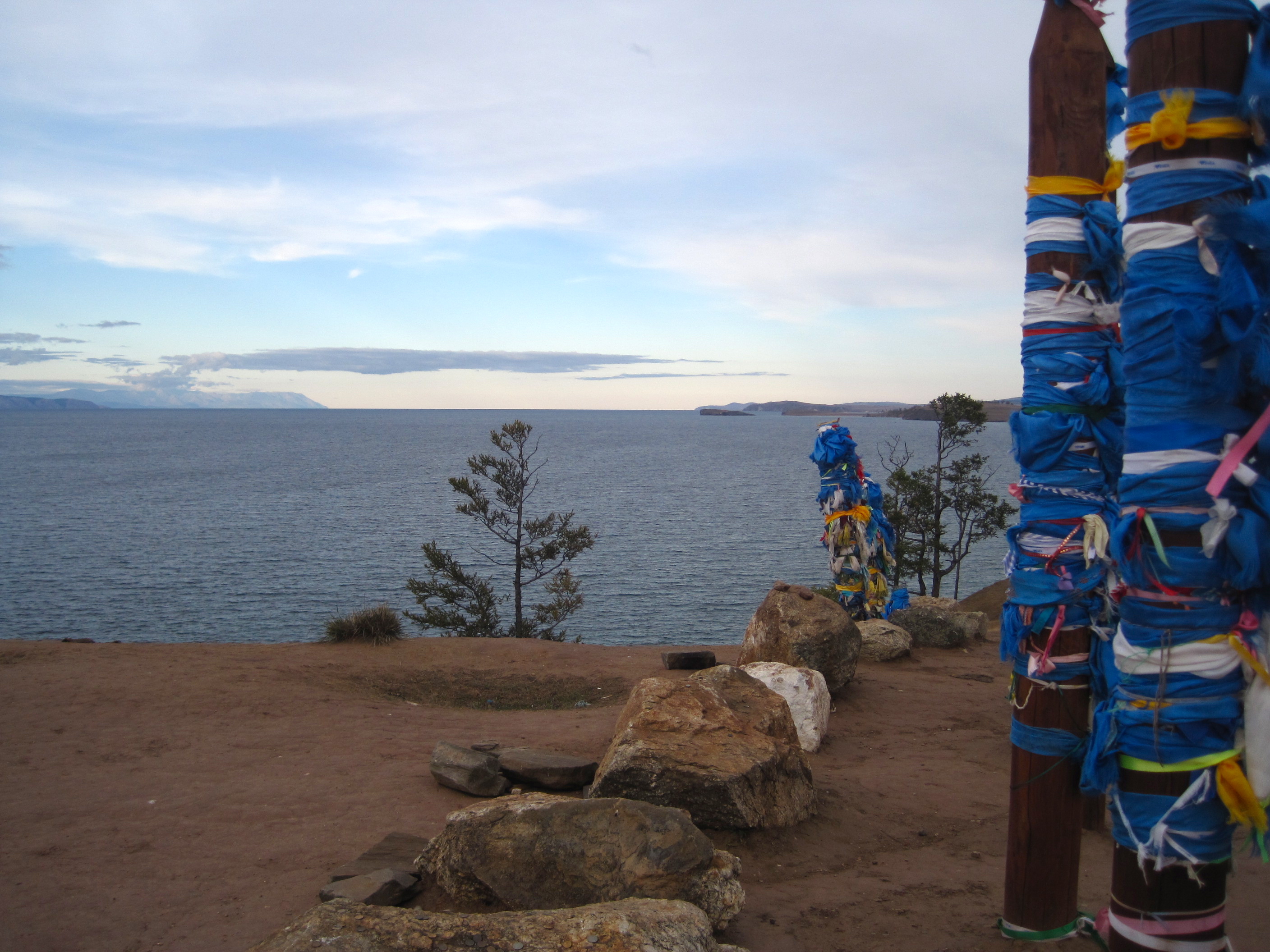
Entry to Shamanka Rock overlook on Olkhon Island
On the microbus from Irkutsk to Olkhon Island, the Russian men around me seemed to keep talking about the fact that I was a woman traveling alone and, if I guessed right, making some allusions to how the young guy sitting next to me might have some sort of opportunity.
I removed my earrings and then I coughed, hoping to look gross.
“Siber cough-cough-cough,” the kid next to me said, making a coughing sound instead of the word because he didn’t speak English (except for “bye-bye”) and I know about thirty words of Russian (bread, cheese, yogurt, no sugar), none of which would have helped at that moment.
The microbus was full of these coughs. The guy made a gesture to indicate that it came from one’s insides being rattled all around on Siberian roads. What I had noticed was that no one in Russia blew their nose in public, but it seemed perfectly acceptable to hack into the open air in a mini-bus crammed tight with people. An old man in the back with a big fur hat, sunglasses, and a patch over one eye, coughed loudly, as if to emphasize my point.
We were shoulder to shoulder, and thigh to thigh, which didn’t help my attempts to withdraw from the match-making conversation that appeared to turn crude at the end. Sensing this, I shot one guy a look and he quieted, proving my theory.
The man carrying the cat in a cage cracked another beer, and the four young people squished into the back back seat fell asleep again. The two men who seemed like old Russian gangsters leered at me still. And the man with a goiter on his jaw, fists clenched tight to a twelve pack of cigarettes, had that sickening, metallic smoker’s breath and half a mouth of rotting teeth. His hands were tattooed and fading, like one of the gangster’s. The other gangster wore nice eyeglasses and looked rather erudite.
I balled my scarf up behind my head and closed my eyes, even if it was impossible to sleep. The road was paved and bumpy for the first three hours, then turned to dirt and large gravel rocks, mixing our insides up to produce that choir of coughs. And our driver drove in both lanes depending on what was most convenient, and passed often with nary an inch to spare.
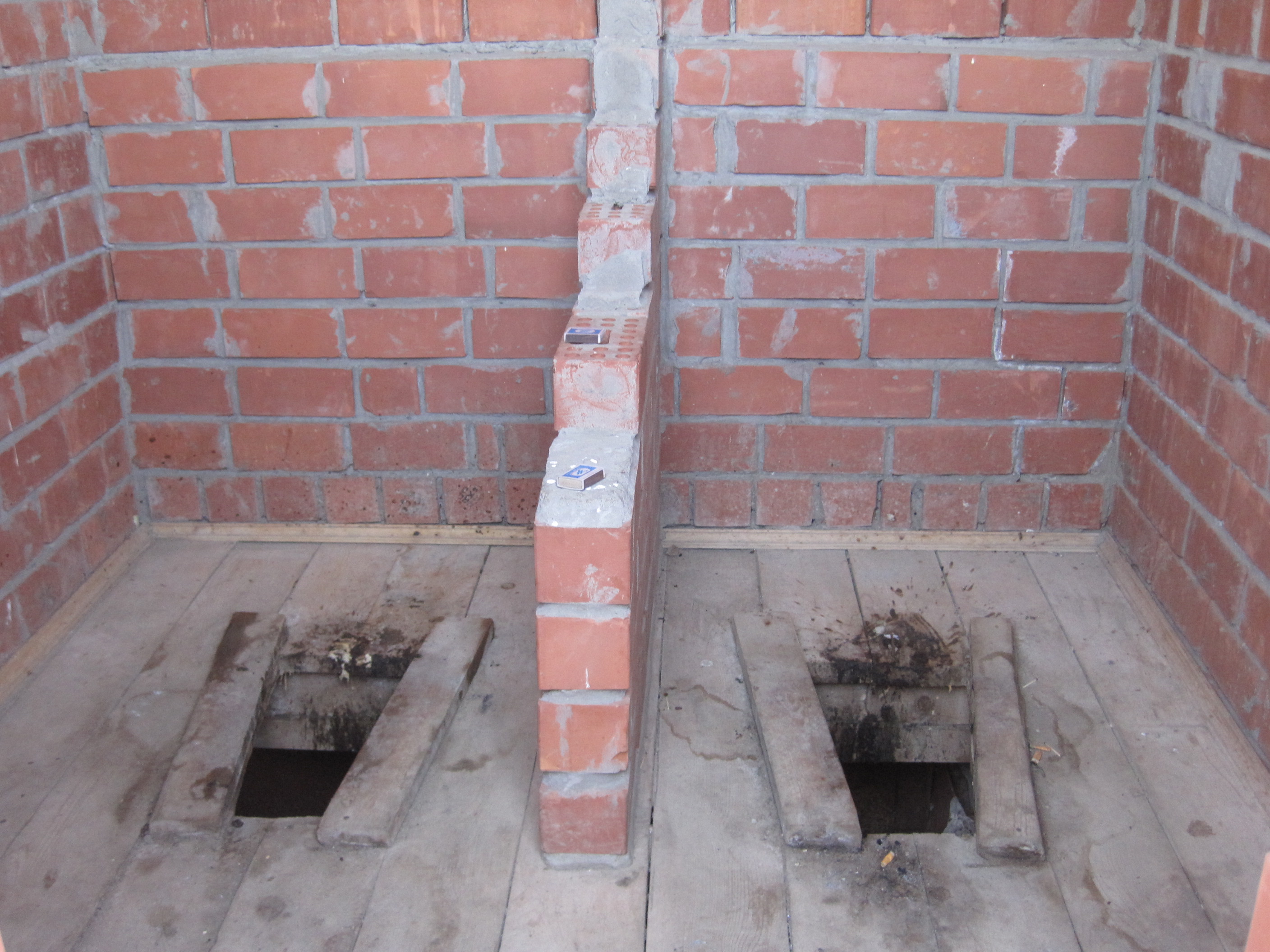
Oh, I’m sorry, you thought rural came with two-ply, huh?
The women’s toilet on the way to Olkhon Island, with two stalls. Just to be clear, at island accommodations, the toilets are your familiar ceramic.
* * *
We arrived in Khuzir, the largest town (at 1500) on Olkhon Island, in the late afternoon. The driver deposited me and the two British kids who’d been sleeping in the back seat at the door of Nikita’s Homestead, an accommodation that no guidebook ever described with much detail, but always seemed to like. My friend in Irkutsk has said, “If I were going to Olkhon, I would go to Nikita’s. It has very good energy. I would want to go there and do yoga.”
I told her she was speaking my language.
Olkhon Island itself is about halfway up the west coast of Lake Baikal, about 3000 miles east of Moscow, a bit north of Mongolia, and deep within southern Siberia. The lake is, among other things, considered the center of Shamanic culture (it is within the Buryat Republic of Russia), home to 3400 or so species, most of which live nowhere else on earth, and catchment for 20% of the world’s freshwater. It has a surface area comparable to that of Belgium.
I hadn’t done much research about anything before embarking, except to learn the Cyrillic alphabet, which I still consider my crowning glory. When I finally did get to reading about Lake Baikal, it was after I’d booked my onward train tickets and received my visa with a very precise exit date. That date gave me four days at Lake Baikal, before I would need to get on a train to Ulaan Baatar.
Once I began reading, I wanted to do everything – hike around Olkhon, eat omul in Listvyanka, visit the datsan near Ulan Ude, ride the Circum-Baikal Railway, just for starters.
What I also learned was that to drive the length of the lake would be like driving from Los Angeles to San Francisco on a one lane, partially paved highway. To drive around it (or across it, which you can do when it freezes over in winter), would be roughly equal to driving from LA to the Nevada border.
In short, the lake is really far away from things and things around the lake are really far away from each other. Fitting more than two into four days would be tough. So I opted for a night in Listvyanka, a built up weekend destination for Irkutsk residents, and then a marshrutka to Olkhon Island for two or three nights.
And so there I was, after a seven-hour drive, standing in front of a very curious building in a very rural town. I was with a British couple who had been sleeping in the way back of the marshrutka. A cow across the street mooed and a stray dog ran by.
* * *
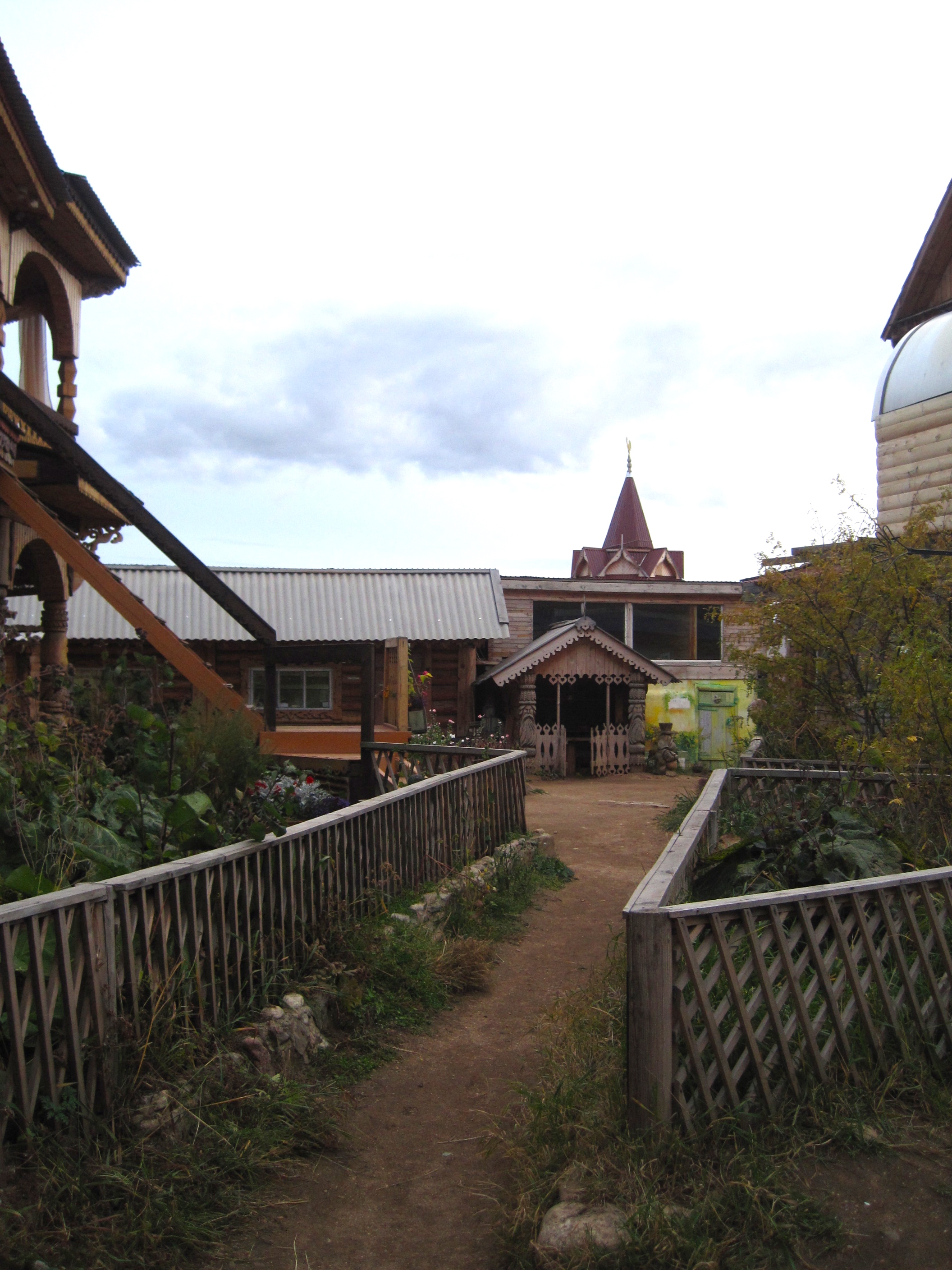
The Harbin of Siberia – Nikita’s Homestead, Olkhon Island
At the end of dinner, when it was just me and the two Brits from the marshrutka, an older man tottered in. He had the worn face of an Olkhon Islander – thick grooves running down his cheeks, the bags under his eyes loose and weathered – and after watching us and the other group – Russians who I think live here on the island if not at the homestead itself – he sat down with us.
He told us about the homestead – “this is why we’ve tried to build paradise here” – and about the “master Nikita, though I suspected he might be Nikita.
He liked Tom and Sarah better because they were British, and he preferred all things British. He pretended it was hard to understand me.
“Americans,” he said, “they chew their words.”
The little kitchen cat who had no name ran around. I picked him up and petted him until he fell asleep on my lap.
The gentleman then got up and went to the piano, told us about an old Romeo and Juliet film he had seen in his younger years, and how he was taken by a song.
“I think maybe you will recognize the song,” he said, and began to play a beautiful melody. He sang as well, in a gruff, rich voice that sounded as weathered and wonderful as the island.
I didn’t recognize the song and I hadn’t seen the movie, but the moment was one of those that you often only read about and I loved this man and what he had built here on the island – “a special place,” the German guy who comes here each year to work for a few months had said. “I think the people in Irkutsk want to come here to get away from the city.”
Of course, I laughed. Isn’t this really the human condition. In Perth, I had gone for dinner at a friend of a friend’s house. They were thrilled to have just moved to the hills outside of Perth, where they had half an acre, chickens and a garden. At home, my friends were all dreaming of moving to Sonoma, Sebastopol, and the like.
Even here, in what feels like far from everything, those in Irkutsk go north to this little-populated island to get away.
Of course, in summer, they bring trappings of the city with them – there is a yoga teacher in the village all summer, a kung fu teacher, and “energy workers.” But they have all gone home now. It is the first of October and the wind has become very cold. The sun appeared this morning, but it disappeared behind a cloud quite quickly. “Brisk” would be a generous word to describe what it feels like here.
At breakfast the next morning – they serve guests three meals a day included in the price – I wondered if Nikita would show again. He teaches at the school in town and we had tried to invite ourselves there as part of one of their cultural lessons in English class. He said he would get back to us that day, though I wasn’t sure if it was politeness or genuine.
The little black and white kitten snuck up onto my down vest and made himself at home. I named him “Tchotke,” which I thought was the word for prayer or meditation beads. But the Russian guy in the kitchen said it sounded like the word for “right” (as in the opposite of left), which is fine. He is little and will grow into the appropriate name.
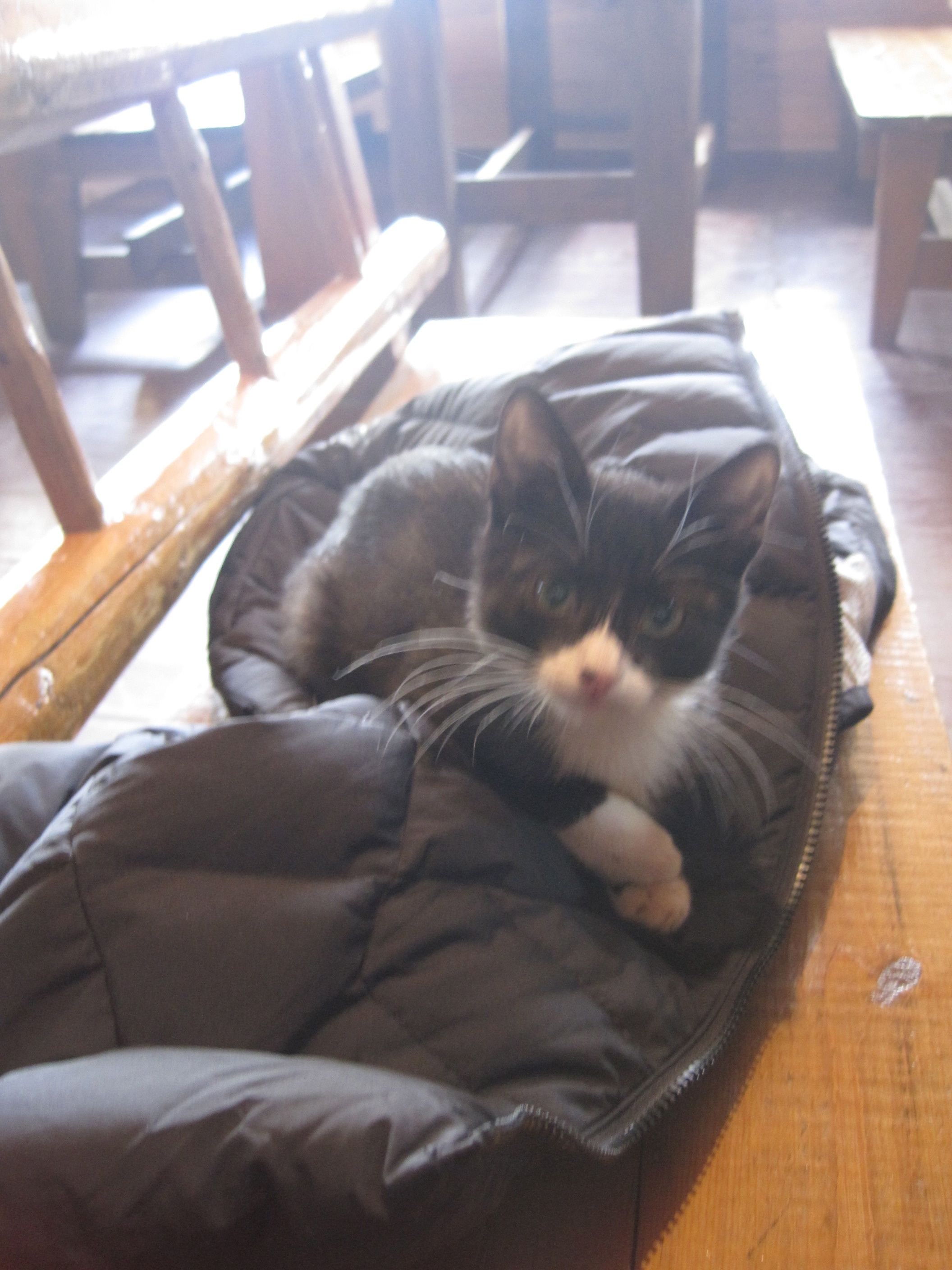
Tchotke the kitchen kitten