How to get around Western Australia and the Northern Territory
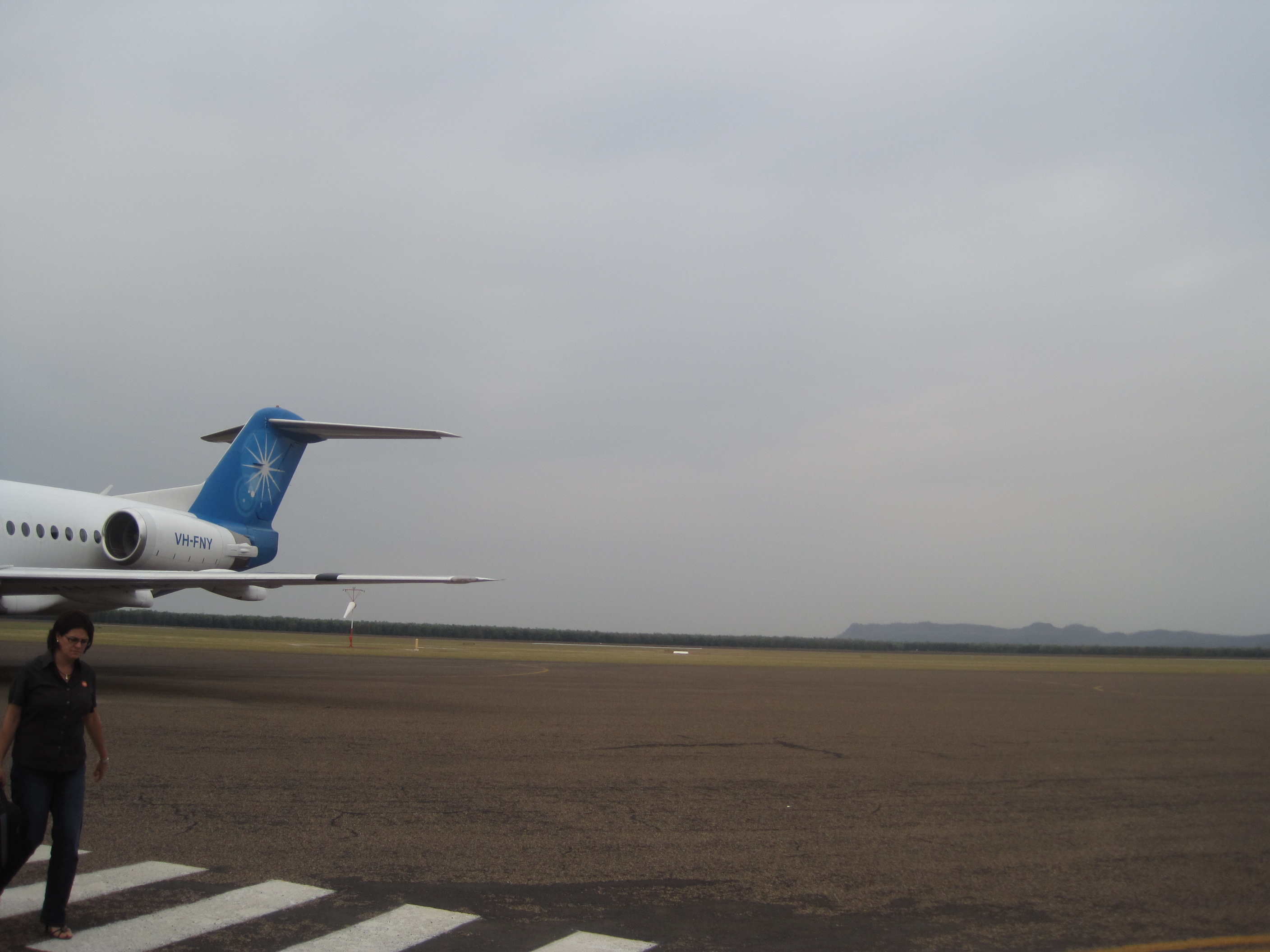
There isn’t much to the Kununurra airport, and I love it like that.
Western Australia and the Northern Territory provide the independent traveler large expanses of unpopulated, varied, and raw landscapes, ranging from bone dry deserts to pristine azure beaches to the tropical rainforests of the top end. These are places one goes when one seeks emptiness, aloneness, or an experience outside the usual front-page travel circuit. After all, Western Australia covers one-third the continent, but holds just a smidge more than 10% the population (and most of that in Perth!). The Northern Territory holds less than 2% of the country’s total population.
But such low population numbers mean public transit is sparse, if existent at all. I wanted to get to a friend’s house in Guilderton to write, but just could not find a way there, short of hitchhiking (and as a single traveler, I didn’t even consider that an option). On the other hand, I got to another friend’s house in Quindalup without a problem – I snagged a ride with a girl I’d met on the Indian Pacific.
Western Australia and the Northern Territory really are marvelous and worth getting to, but the getting-to can often be a daunting and costly feat. So, how can an independent traveler see WA and the NT smartly and within budget?
Here’s some of what I learned in the two months I spent traveling Australia’s empty west and north alone and as “on the cheap” as I could.
Nothing is “on the cheap” but some things can be cheaper
Buses: Greyhound runs the only interstate bus service, and tickets from Perth to Broome or Darwin can often cost as much or more than flights to the same places. But sometimes, the company will run deals so stay tuned in to their fare alerts and check with budget travel providers like Peter Pan travel. Some of the girls I hung out with between Broome and Darwin found a special ten days of travel for $320, which got them from Darwin to Alice Springs to Cairns for way less than any other option.
Flights: Air flights to cities in Western Australia and the Northern Territory are costly in comparison to a round-trip to Bali – that’s often the reason Sydneysiders have never even been to Perth. But sometimes you can find relatively good deals. Since flight aggregation sites like Kayak, SkyScanner, and Chase’s Ultimate Reward (the three I used) often won’t include all regional carriers, I would scope out the details of the flights listed by the aggregators to find out who was operating the one I wanted. Sometimes, I would find the ticket for much cheaper on the operator’s own website than through the aggregation website. For instance, in seeking a ticket for Broome to Kununurra, the cheapest ticket I could find via an aggregation site was approximately $300 on Virgin Australia, for a flight operated by SkyWest. I checked for the same flight directly on SkyWest’s own website and found it for $100 cheaper.
Trains: There is a network of trains in Australia, mostly on the east coast, which are a mix of privately and publicly operated lines. Two lines provide services to the west and to the north – the Indian Pacific and the Ghan, respectively. (I took both of these – for more on that see: On the Indian Pacific and The Ghan.)
RailAustralia offers a variety of passes including a three-month pass for the Indian Pacific and the Ghan (approximately $450 AUD). The pass is great deal if you plan to travel both lines.
The Indian Pacific runs from Sydney to Perth with scheduled stops in Broken Hill, Adelaide, and Kalgoorlie. The Ghan runs from Darwin to Adelaide, with scheduled stops in Katherine, Tennant Creek, and Alice Springs. Both trains seem to also stop in various other towns along the way if there are passengers looking to get on or off. Even with a pass, all bookings must be pre-arranged with Great Southern, the train’s operators.
Also, keep in mind, the lines have a limited schedule: the Indian Pacific runs once a week; the Ghan runs once a week in the low season and twice a week in the high season. That means, plan accordingly. The schedule actually ended up putting me in Alice Springs for seven days, which at first I thought would be painful, but then found to be so pleasant I hardly wanted to leave.
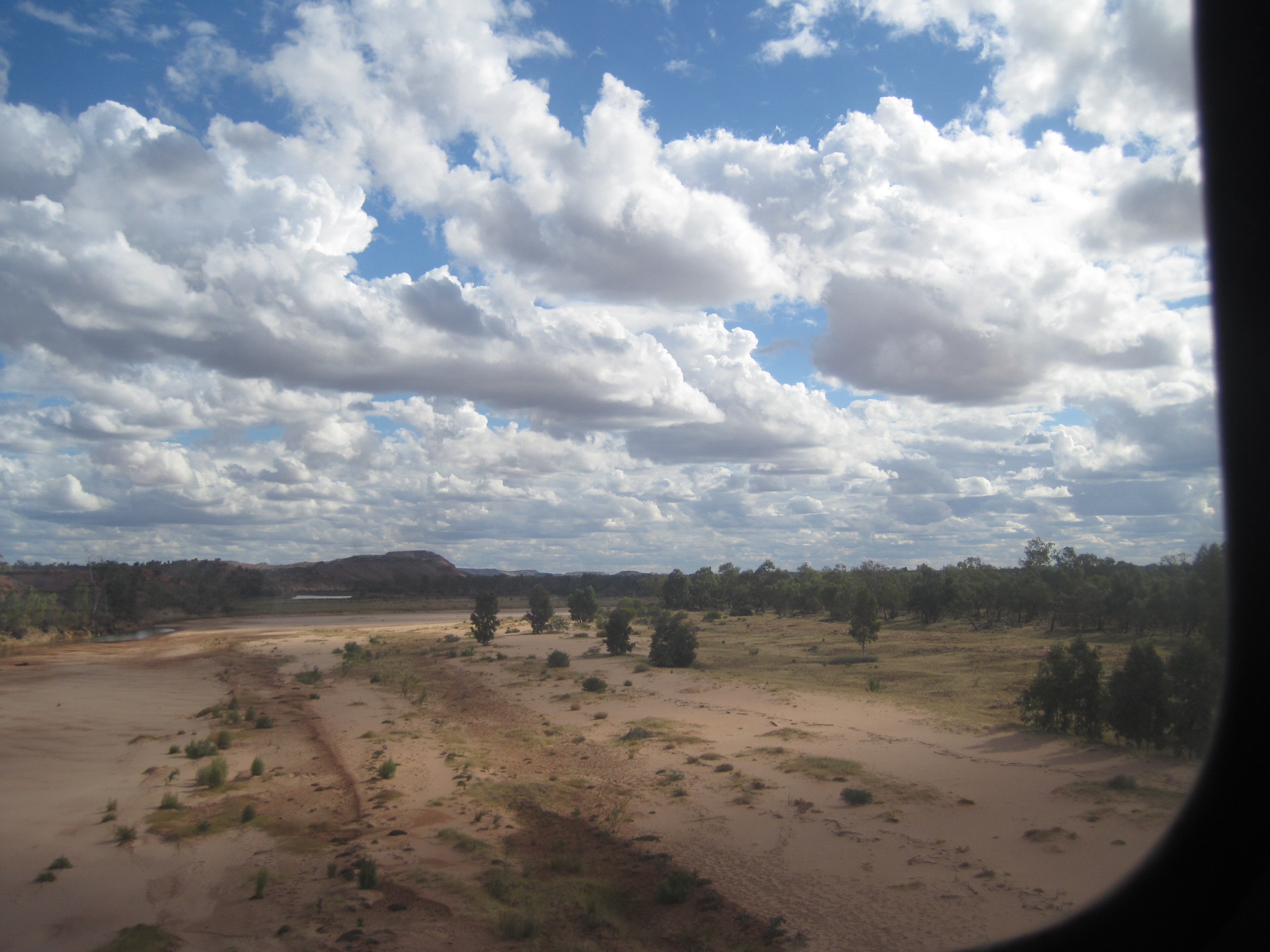
The clouds have a whole different quality around Alice Springs, Northern Territory
Campervans: Campervans are probably the most common way for travelers to see the coast north of Perth, and are the way all the Europeans and fellow Commonwealthers on working holiday visa do it. These guys all seem to leave Perth in March or April to begin the trek toward Darwin, where most will try to sell their cars and either fly home or fly to Southeast Asia.
Getting a “lift”: Many travelers have space in their campervans and are looking for travelmates to kick down some cash for gas and food. If you’re not too picky about your precise schedule and can go several days without a shower, getting a “lift” in a campervan will introduce you to some cool people and to every kilometer of the west’s shoreline. The best way to find a ride is to use GumTree, a message board website like Craig’s List but with a more limited, traveler-oriented scope.
Renting your own: There are also tons of companies that rent out campervans with varying requirements on length of rental and drop off points. All companies will tack on a hefty fee if you want to drop the van off somewhere other than where you rented it, and many will also apply a “remote location fee” if you’re picking up or dropping off in Broome, Exmouth, Darwin, and sometimes other west and northern locations. But if you want to do it on your own, rather than in someone else’s car, book early. In doing preliminary research of my own two months before I left I found some deals, whereby I mean $2000 AUD for a month’s van rental with pick up in Perth and drop off in Darwin, gas and insurance not included.
Relocation service: Campervan companies will sometimes be looking for people to “relocate” a campervan from a remote city to a more populated city where it’s needed. In those cases, you can often get a campervan for the cost of insurance; sometimes the company will even include a petrol stipend. Relocation options are listed on a variety of websites (just Google “campervan relocations Australia” and you’ll find aggregators as well as individual rental companies’ relocation options).
I got a lift from Kununurra to Darwin with some girls who were doing a relocation from Broome to Darwin. Relocations are a great way to move between cities for cheap, but the days are limited and you’ll often find yourself needing to cover between 400 and 800 kilometers in any given day if you expect to get the van back on time (and penalties are severe if you don’t). Relocations are also a lot of sit-and-wait-then-hurry-and-go; you might hear nothing for a week and a half, then get a call from the company at 5pm to pick up the van at 8am the next morning. When all is said and done, we had a fantastic time; the van was way nicer than anything we would have rented ourselves and fit five, which made the petrol cost per person quite manageable.
The Northern Territory, in particular, is very hospitable to road travelers. State-maintained 24-hour roadside camping areas crop up every 100km or so. These are free but unpowered. Campervan parks with powered sites, where you can recharge a battery, or keep your refrigerator cool, also dot the roadsides; these are privately operated and usually charge by the person.

Camping at a 24-hour roadside campsite in the Northern Territory, on the way to Darwin
Car rentals: There are no “cheap” car rental options, particularly out west and north where many companies will put limits on mileage and/or assess “remote location fees”. But planning ahead and doing thorough research will almost always result in a better deal than some last minute wander into the rental car office in town. Car rentals are particularly good options if you want to fly into cities like Broome or Kununurra, then go camping out in the back of the beyond. For that type of activity, a four-wheel drive is almost always required.
Crew a boat: Boats sailing around the coast are often looking to pick up folks who will do work in exchange for transport. My boater friend tells me sites like Find A Crew and Yachtingcrews.com help interested travelers find boats. He also says that in April and May, most boats are heading from Darwin south to Perth/Fremantle. I’m not sure what level of expertise and experience is required, so I leave it to you to do the research if you’re interested.
Hitchhiking: Interested in traveling really cheaply? There’s always hitchhiking. But to be frank, I’ve heard more native Australians than not say they would never go hitchhiking out in the bush, and if you know Australians, this says something – they go swimming in Great White waters with hardly a concern. As they tell it, the Outback attracts a particular sort of person that might sometimes be characterized as “crazy.” But, hey, if you like that kind of thing, don’t let me stop you. Just remember, you might be stuck out in 300 miles of empty desert with this person and hardly another soul.
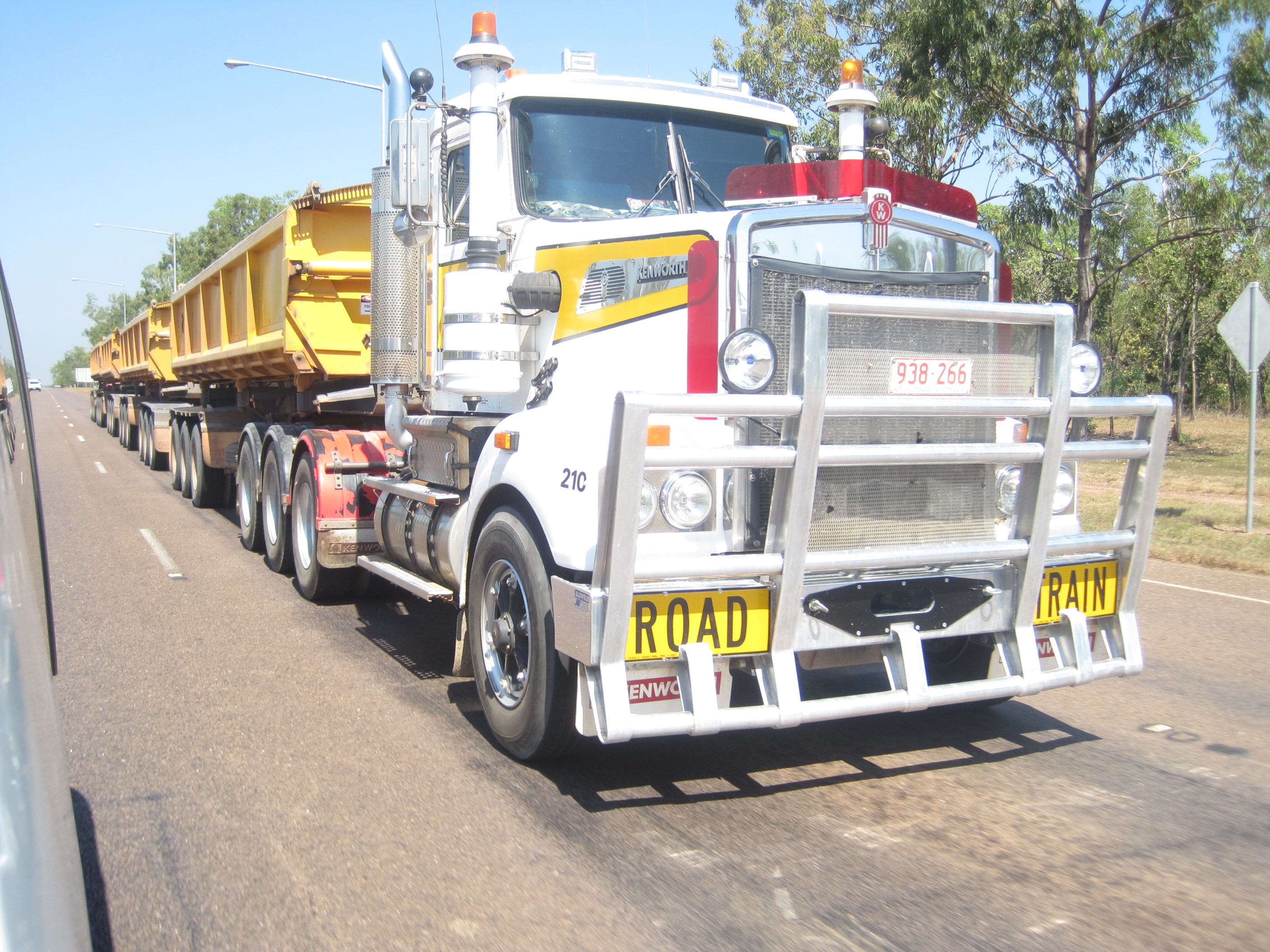
I also met a girl who had gotten around WA by hitching with road trains, which are like extra-extra-long eighteen wheelers. She had a friend in the business, so the drivers came vouched for. I’m not sure this is all really legal so it’s up to you whether you try thumbing a ride at a roadhouse somewhere.
Really getting “outback”: The cities in the north are small, but they’re still cities. In the end, the only option that will really get you out of towns is to have your own car or to be in someone else’s car. Australia’s phenomenal natural parks and empty Outback are absolutely worth it (have I said this enough yet?). Before you go four-wheeling off into the bush, though, make sure to learn about wildlife in the area (i.e. protocol for camping in saltwater croc territory or whether it’s box jellyfish season), research your routes, know how to change a tire, and plan your petrol, because when I say there’s nothing out there for hundreds of miles at a time, I’m not joking in the least.

In a campervan, unlike a train or a plane, you can feel the warm sunset air on your face.
Cost of living and cost of transport are two different things
I knew the US dollar was fairly weak compared to where it had been years and decades ago, but before I left I felt fairly certain of my research, at least transport-wise, and felt that my immaculate “travel costs” spreadsheet would be quite accurate. But transportation costs and living costs are two very different things: when researching a trip, don’t forget to find out how much your average cup of coffee costs, or your average café breakfast.
It’s the café breakfasts that could have broken me: a bowl of yogurt and muesli will cost you $10 minimum, just about anywhere in Australia. An eggs benedict something more like $17. Most backpackers I met were carrying loads some ten to twenty pounds heavier than they ever had in Southeast Asia, entirely because we were all shopping at the supermarket and taking food with us to keep costs down. I’ll post more on the traveler’s diet soon.