Spring Onions, Bacon and Other Stories from Alice Springs

Alice Springs from Anzac Hill
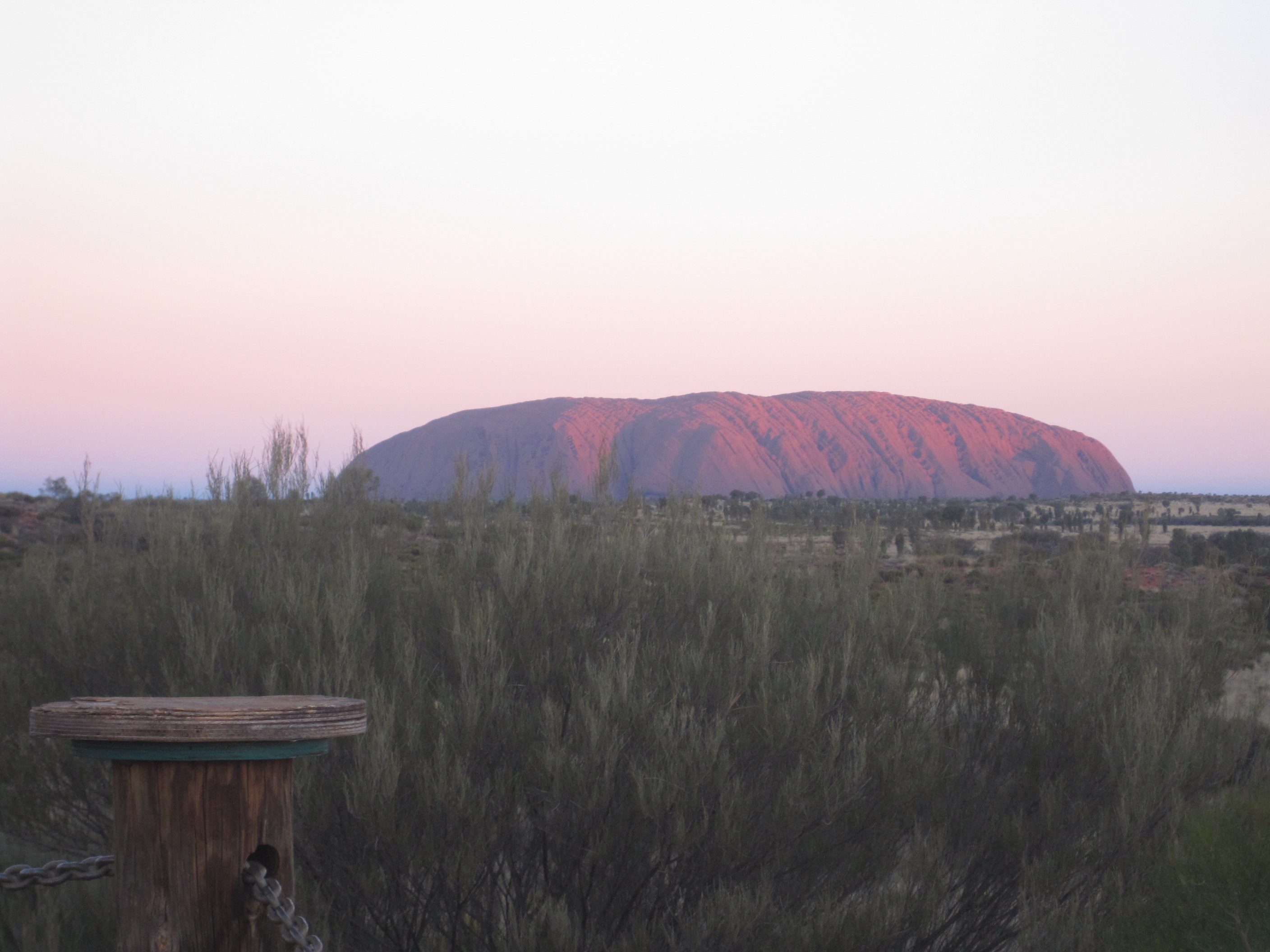
Most tourists don’t come to Alice Springs to be in Alice Springs. For many, it’s just a launching point to get to Uluru (formerly known as Ayers Rock), the massive and ancient swooping stone monolith some 300 kilometers west of the city.
I hadn’t come to Alice Springs to see Alice Springs either. What really could there be in a town 1500 kilometers removed from the nearest big city (Darwin)? I expected it to be a similar cultural backwater. Compounding matters, a few weeks prior to my visit, news reports came out about some aboriginal boys who had broken into a campervan and assaulted and raped the two European female backpackers inside. This only increased latent white-aboriginal tensions in the town and amongst the backpacker set.
If given my druthers, I probably too would have arrived, gone on a tour, and left immediately. But I was bound by my mode of transport, the Ghan, which only runs once a week, to either no days or seven days in Alice.
With all this in mind, I booked a tour (the only easy way to get to the rock and other places in the area) for five days and four nights – the longest tour I could find – and one that promised sleeping under the stars, meals cooked by campfire each night, and lots of hiking.
There’s a ton of companies running tours out of Alice – most are backpacker tours, meaning a cheap whirlwind drive to Uluru, Kata Tjuta (the Olgas), and Kings Canyon; some are all-inclusive coach tours designed mostly to get pensioners a photograph and a checkmark on the travel checklist; and a few give you something in between for a bit more money than the cheap-o backpacker version.
I decided to do one of those. I picked WayOutback Tours, which is, from what I understand, the only locally-owned company of the whole lot. Its slogan is: “The masses go outback… only the enlightened go Way Outback.”
I had a day to kill in town, so after I got settled at my Couch Surfing house, I pattered around the Todd Mall, the four block long main thoroughfare in town. The day was crisp, like I’d arrived in the California high desert in springtime, and I tugged my musty Smartwool overlayer down over my thumbs – I hadn’t used it since I’d left Perth four weeks before and was frankly quite surprised by the temperature in Alice anyway, a crisp 18 degrees Celsius.
Several boho cafes stood out, playing reggae and rock, and catering to well-dressed, normal looking people. They didn’t seem like the crude guys in Broome or the plastered partiers in Darwin. I headed up to Piccolo’s, recommended by the lady at the information center, for a flat white, and decided to get a pumpkin soup with bacon as well.
Both choices delighted me.
Having cultivated my espresso snootiness in order to fit back in to Sydney, I was quite pleasantly surprised by the flat white.
“Who roasts your espresso?” I asked the waitress.
“Oh, it’s local. Duncan just outside of town does it. I don’t remember his company’s name.”
A locally-roasted espresso? Who would have expected such enterprise for a town of just 30,000? Later I would find out there’s not just one local roaster but three! With that kind of competition, Alice should have the best coffee in the country!
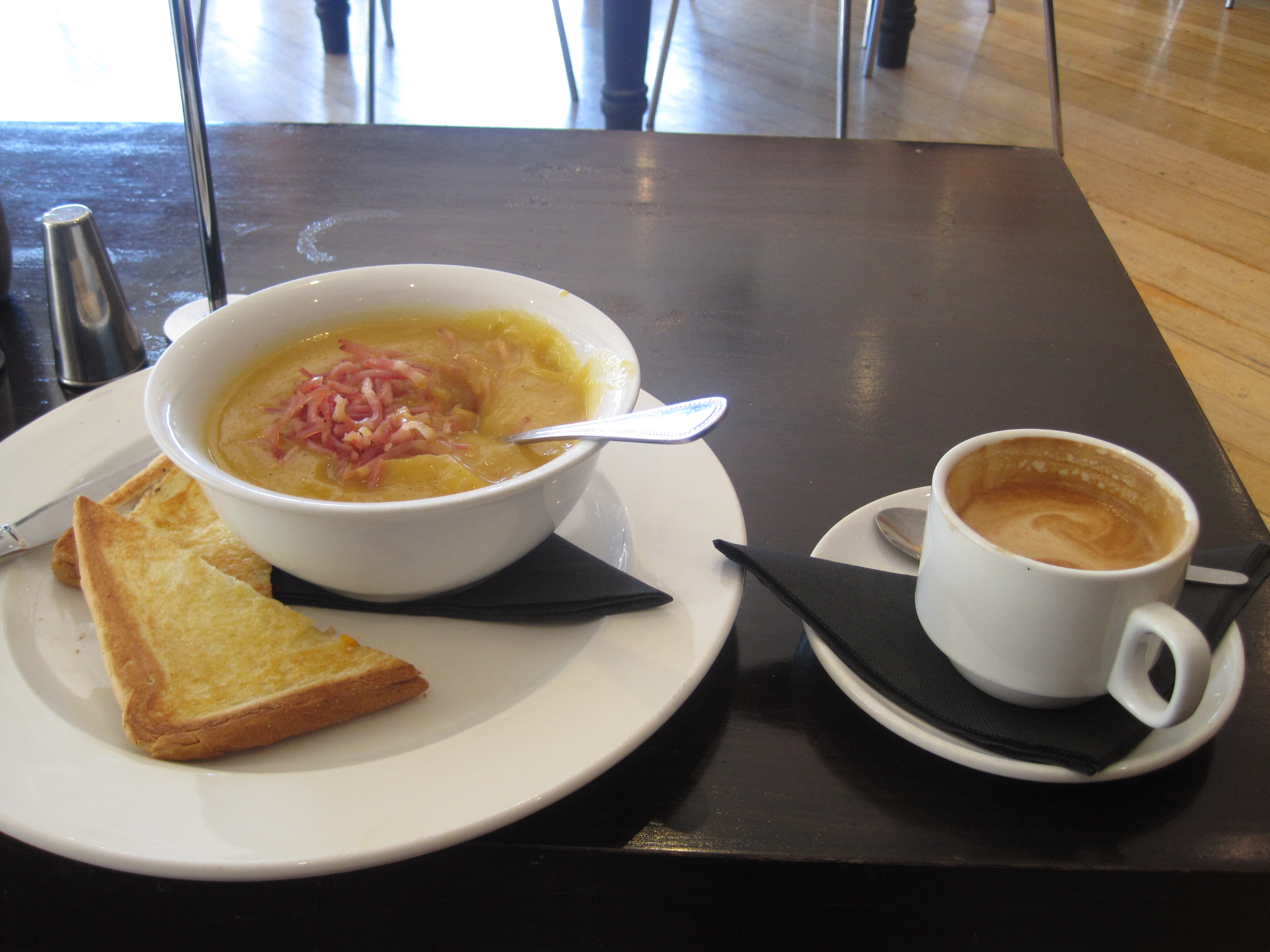
Bacon garnish, how hip
From the looks of the café, the town is young and fairly lovely. The Todd Mall has as many boutiques and second hand stores as a small neighborhood in Sydney would, only the people are less snooty and the cobblestones make it difficult to wear heels (thank god).
I ducked into a bookstore dedicated to Australiana books and the proprietor told me about several. I perused the photos in a few about aboriginal history and about the early cameleers, or as I like to think about them, the original “road trains.”
After the soup, I decided to walk up Anzac Hill. The hill is hardly a blip on an elevation map, but it gives good visibility to the terrain of Alice. Several squat mountain ranges come together here; Alice Springs is nestled (and I use this word unhesitatingly and without cliché) between them. It fits right there, like a little egg in a birdnest, without sprawl or complaint. The train tracks cut along the southwest side of town and, out to the east, I could see the street I was staying on. Though my host had kindly given me a lift back to town after I’d gotten settled, he hardly needed to bother; the walk was less than ten minutes.
In the afternoon light, the colors were muted by the brightness. As I understand it from my CouchSurfing host, professional photographers would do well to underexpose their photos in this country; this is because most cameras are manufactured in the northern hemisphere and are calibrated to light levels there. They are not made for the light of the southern hemisphere.
And it’s true, the light here is powerful, so much so that the sky routinely comes out looking white in the photos I take with my little handheld, despite its periwinkle coloring. At the sun’s height the colors are muted and not too distinguishable. It is at sunrise and sunset that the vibrancy arises.
The air was chilly and I shivered a bit. I tried out all four benches at the top of Anzac Hill, one pointing each direction, and settled in to the one that felt right. I took the opportunity to close my eyes and breathe. I reveled in the absence of mosquitoes and humidity. I wondered if I didn’t maybe prefer this type of air overall, despite my recent enjoyable sojourn with the humid sub-tropics. Then I noticed that I was thinking rather than breathing, and returned to my breath.
The whole breathing experience was so pleasant that I eventually got distracted by the thought of a yoga class. Maybe Alice Springs has one, I thought. So I pulled out my phone and searched this on the internet. To my surprise, I found at least four.
I picked the one that said “meditation” and “chanting” in its description and not the one that said “fitness.” I gave the studio a ring and the teacher answered; she invited me to the class that very evening. She said if I could take the bus there, surely someone would give me a lift home.
Well, I was starting to like this place.
The yoga – Satyananda – was a blend of my favorite practices: chant, breath, yoga nidra, asana, and a final meditation. The studio was a room in the teacher’s home. Her backyard had a lovely pool with a large Om symbol hanging on the wall behind it.
Sadly, I learned that Satyananda is predominantly a practice in Australia, and would be difficult to find back in California. Score one for Australia there. Also, sadly, there were no other classes in the rest of the short time I was in town and not on the tour, so I would have to take this one with me and remember it fondly. Or come back. I started to fantasize about coming back just to study Satyananda yoga with Kalika.
“I knew when I spoke to Kalika on the phone that she was special,” I said to the woman who drove me home.
“She’s been teaching here in Alice for twenty years and I’ve been studying with her for the same amount of time,” the woman replied.
According to my tour guide, who I would meet a day later, most of Alice is made up of people who “came here for a week-long holiday and that was six years ago.”
According to my CouchSurfing host, you either love Alice or you hate it. Very few fall in between.
The country around Alice Springs – Central Australia, more or less – is magical. It holds colors I thought were not natural: creamsicle orange, fluorescent pink, iridescent silver, and that pervasive violet of sunset.
“There are some people in town,” my tour guide said, “who say that Uluru is one of the chakras of the world.”
The country holds tens of thousands of years of human history, captured in paintings, rock carvings, stories and songs, many of which, having arisen from an oral culture, are unlikely to have been recorded and are being forgotten by newer generations.
Every hill, valley, and waterhole might be an animal, which is also a totem, the progenitor of a clan, a participant in a story; it is the site of an event, it is a teacher of morality, and a direct ancestor of the indigenous people here. It holds a romance I can’t escape: imagine if we learned stories of our ancestors from a young age, ancestors who have returned to the land on which we walk, who are effectively within the land, so that each time you move or use a natural object, you too are attached to it; these stories might teach us how to live in and eat from our land, might teach us when a plant flowers, and which is edible, might teach us when rain comes where and when water holes dry up. Imagine if our worldly education was tied to the use, the history, and the interconnection of natural objects, those that feed us, shelter us, and bring us life.
I can hardly do what I felt here any justice, but I can say that Alice Springs enchanted me as a town and as the human center of a larger natural environment.
Thus, I was pleasantly flattered when our tour guide turned to me one day and said, “You are such a Spring onion.”
“A spring onion?” I asked, confused.
“Like Spring as in Alice Springs. That’s what we call people who fit here.”
I’ve been reading through your posts – really enjoying both the content and your writing style!
Pingback: Nothing is “on the cheap”, but some things can be cheaper: Transportation options in Western Australia and the Northern Territory « Coco in the World