The Ghan and the Australian Overland Telegraph Line
As I write this, I am back on the train again and it feels almost as if I have come full circle. We’ve got the rad crew, the same ones we had on the first half of my Indian Pacific trip. They’ve been at this for awhile so they don’t have something to prove, not like the head of our second crew on the Indian Pacific, who was young, probably wore a slightly too-tight necktie whenever he could, and likely looked at the train cabin I was in and thought, “Oh god, a bunch of backpacking hippies – I’ll have to keep them in line.”
These guys – the rad crew – remember to have a little fun and treat us civilly. They try to give us comfortable seating arrangements as best they can. One of them loves me and sings Beatles songs to me. They generally make traveling in Red Class enjoyable.
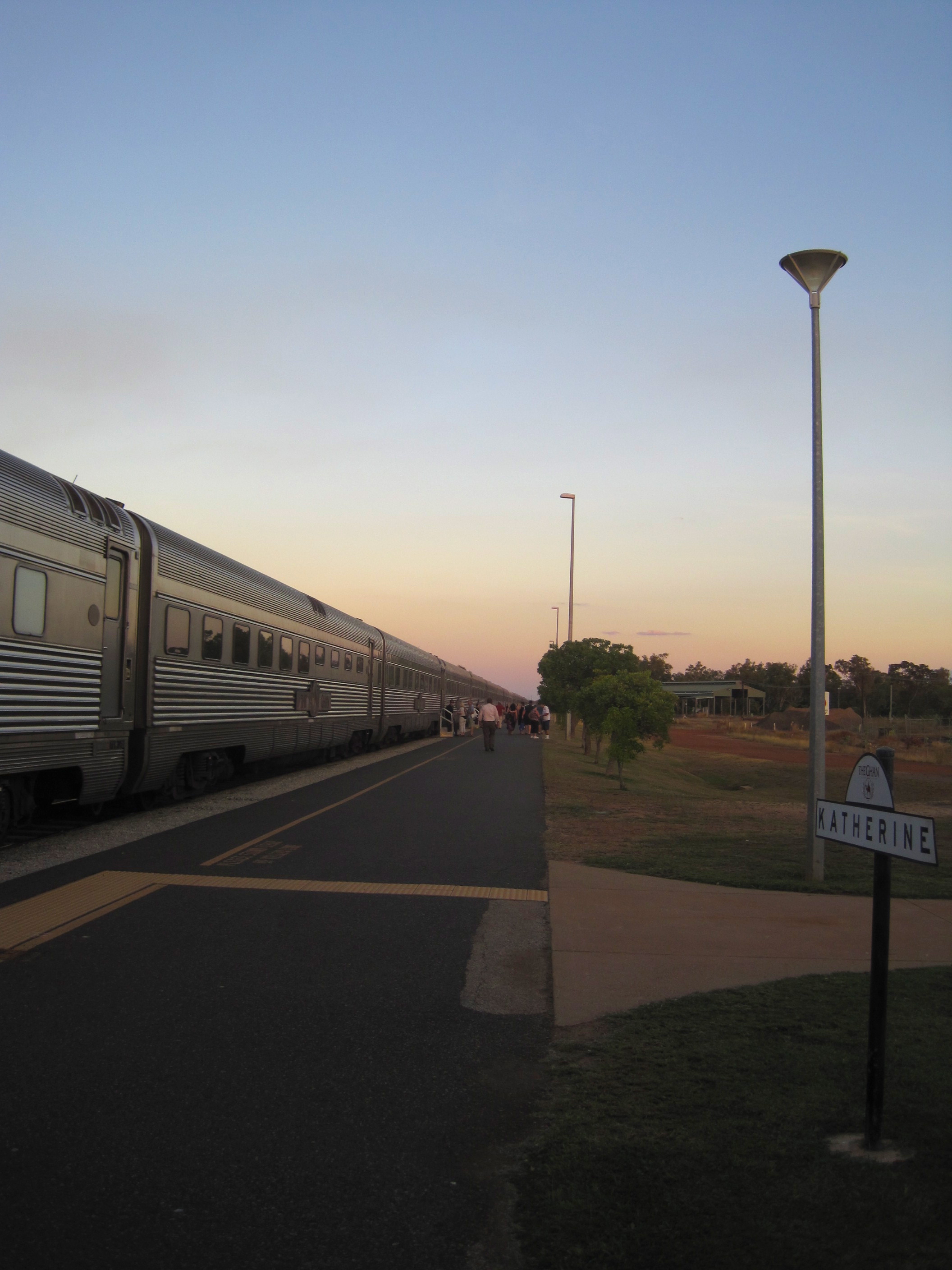
The Ghan at a lengthy stop in Katherine, Northern Territory
The Ghan is a pretty straight shot from Darwin, in the far north of Australia, to Adelaide, in the far south. The trip, if done in one go, takes two nights and a little over 48 hours. It runs through Alice Springs, probably the largest town in the centre of the continent and the traditional jumping off point for visits to Uluru (the rock formerly known as “Ayers”). Most of the train passengers I’ve spoken to are breaking the train trip in two in order to stop at Alice Springs.
The Ghan itself is named after the cameleers (some Afghan, though not all) who came to Australia in the 1860s to transport goods all across the continent. Sadly, they don’t get a lot of press in the history books. As I understand it, they were really the first road trains. They supplied ranchers in far-reaching outposts across they continent, and they helped to re-supply the stations built to service the telegraph line, which was completed in 1872 and ran just some tens of kilometers from where the train line now runs.
The telegraph line took a little less than three years to complete and was viewed as a crowning success for what was the poorest of the Australian states at the time, South Australia and its territory, the Northern Territory of South Australia (the Northern Territory no longer belongs to South Australia, but it is still a territory rather than a state).
The telegraph line is actually much of the reason the towns running north-south through the center of the continent first came to exist. Because the line was so long (some 3200 kilometers), it could not transmit a signal all the way from Darwin to Adelaide without repeater stations. This meant that men would need to be positioned at intervals along the line to receive a telegraph signal and send it further along. The men would live at the stations for some period of time and carry out their jobs.
Oodnadatta, Tennant Creek, and of course, Alice Springs (named after the main telegraph engineer’s wife), were all originally just repeater stations. Over time, minerals and gold were discovered in some of the towns, which drew prospecters. Today, you can still get permits to go “fossicking”. Other towns have large mining operations nearby into which you may not go. And then somewhere out there in the middle of the desert, past Oodnadatta, there’s a bombing test ground where they (who, I’m not quite sure) allegedly set off a test H-bomb in the 1950s or 1960s. As it’s told in Chatwin’s The Songlines, the government put up signs in English warning people to stay away from the test ground but failed to account for the many aboriginal peoples who lived there and did not read or speak English. This neglect is not an uncommon story in Australia’s history.
As the white folks set up cattle stations throughout the outback, the telegraph line became a way for them to stay connected to the “Outside” – this I read about at length in the rather saccharine but classic We of the Never Never. The “Insiders” would often put a little pocket device to the line to hear the gossip further up. This was a primary way they stayed in touch all through the Wet, when many were cut off physically from all else by large bodies of water.
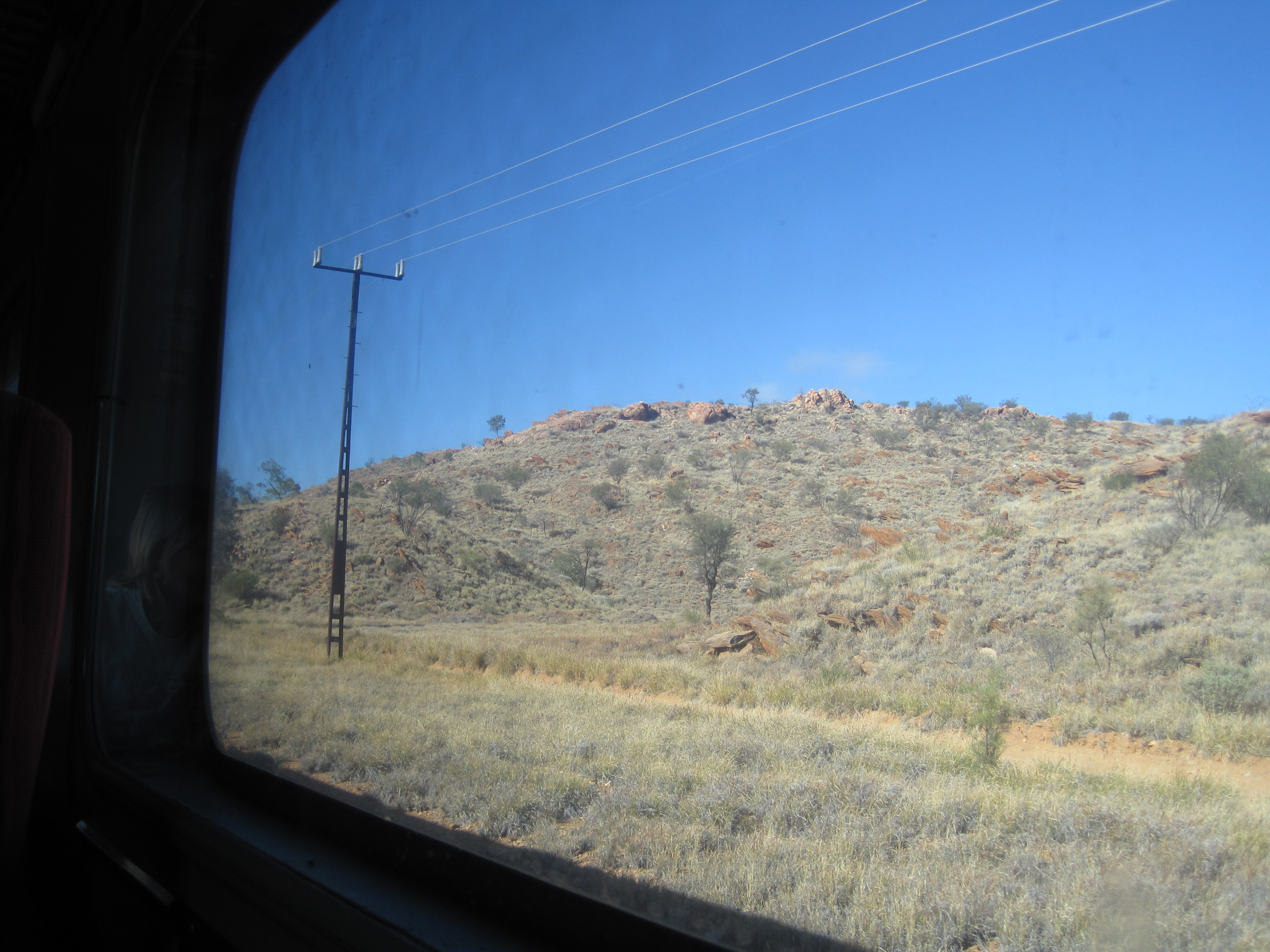
Coming into Alice Springs on the Ghan
I am riding by all of this in the next week. First I’ll stop in Alice Springs, check out the town and take a tour to the rock, to Kings Canyon, and to some other places in the “Red Centre”. Then I’ll hop on the train again to finish the journey, ending in Adelaide. From there, it’s a short plane ride back to Sydney, and then soon after, back to California.
Pingback: Nothing is “on the cheap”, but some things can be cheaper: Transportation options in Western Australia and the Northern Territory « Coco in the World