Travels in Broome, Western Australia
Broome is an outpost of 15,000 in the north of Australia. Look it up on a map. You’ve probably never heard of it unless you collect pearls or you read the article about it in the LA Times this February.
Just for the record, that news article is not what drove me here. That was about fancy eco-lodges and camel rides on the beach. It was actually my friend S, quite by accident and in passing, who sold me on the whole notion of Western Australia, and it started with Broome. She had taken a camping trip north of Perth with her sister and brother-in-law, she showed me the pictures, and then she said, “I hear you could work on the pearl farms up in Broome.”
I looked up Broome and became immediately enchanted with its remoteness. From the tourism website it looks like one should expect an urban oasis in the midst of lush grassland.
I suppose that’s the job of a tourism office.
I am at the Broome Backpackers’ Last Resort Hostel, a lovely little hostel in the midst of a dry, dusty town. The ground is alternately sandy and a deep desert red, perhaps burnt orange. It calls to mind that Gillian Welch song about the red clay that stains her feet. Much of Broome feels sun-scorched. As a precautionary measure against cyclones, the house are all built of corrugated metal siding and roofs. Downtown is just a couple street of storefronts; in certain parts, I feel like I might be on a stage set from Firefly. One of the outer planet’s wild west towns.
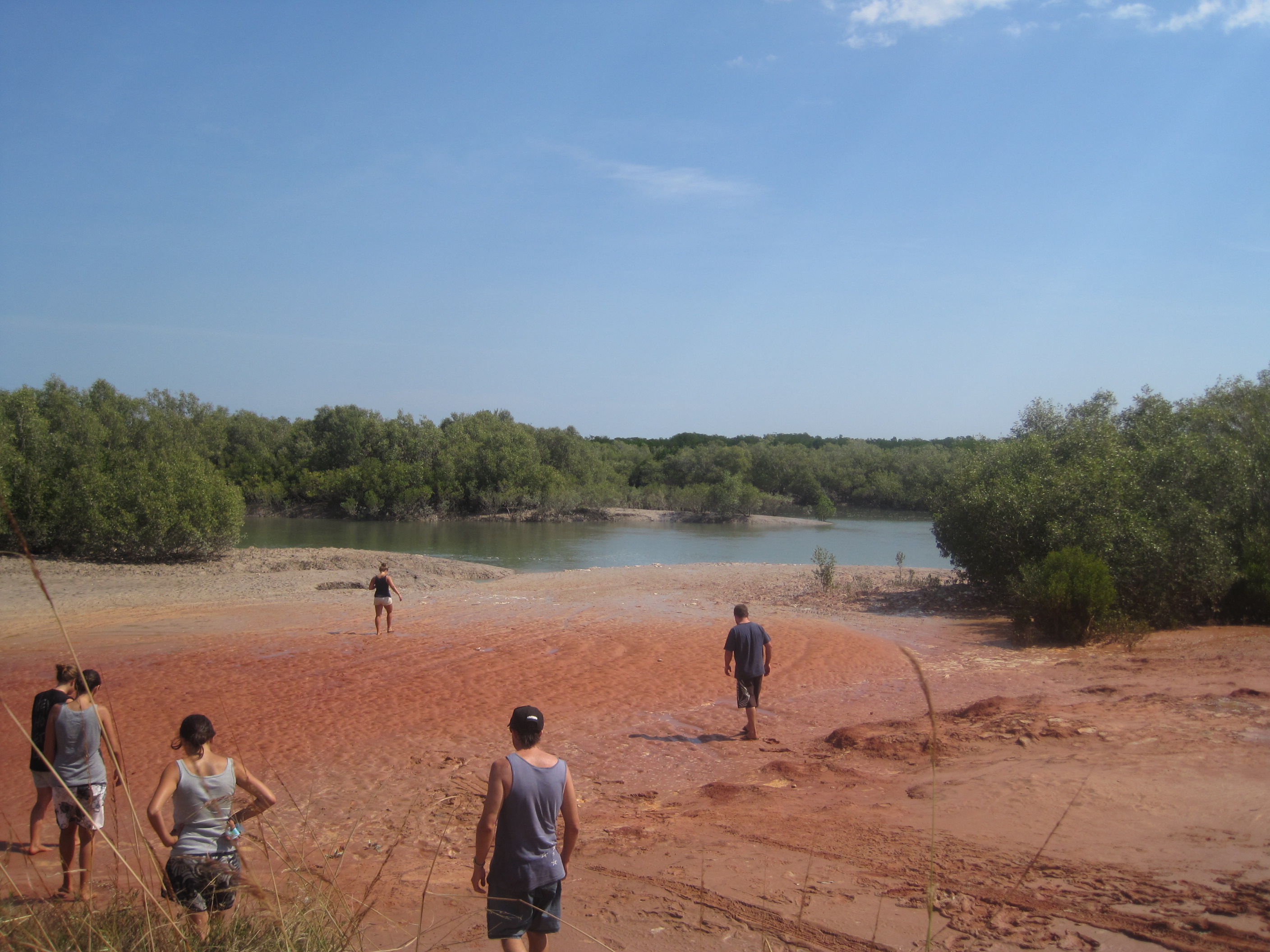
The red clay stained my feet at Barred Creek
Most of the residents I’ve met here are “temporary” by their own admission: many backpackers doing tourism work during the just-begun high season (the Dry, when cold residents of the south flock here for the tropical weather and long beaches); a Brit, come here for a design job; a late-twenty-something with a badass offroad vehicle, moved here two and a half years ago from south of Perth; and a guy from Melbourne who has been traveling for four years. He still considers himself to be on the road, despite that he found a job here and has been working here for twelve months. He lives in the caravan park, possibly in his vehicle, but maybe in a more permanent structure.
Its transience is a concentrated microcosm of much of Western Australia, though Broome’s doesn’t seem to be as intertwined with fly-in-fly-out work as, say, Perth’s. The locals keep close and the backpackers and semi-transient foreigners fraternize.
We went to Town Beach last night – me and the German and Swedish girls I went camping with – to see a natural phenomenon called the Staircase to the Moon. When the lowest tides correspond with the moon in full phase, crowds gather to watch moonrise. When the moon peeks above the horizon it is a deep reddish-pink which then gives way to a bright orange. The moonlight spreads across the empty ocean basin (the tide is out some several hundred meters), creating a ripple effect that appears to be steps ascending to the moon itself.
I didn’t like Broome at first. Perhaps it was the mosquitoes and sand flies that put me off, or the lack of urban buildings. I mean, if you looked at the buildings and lack of trees, you’d too say, “Man, this is coun-try.” But now that I’ve settled into the hostel life and have begun to adopt Broome-time. “Broome-time” mostly means we wait around until noon for the shuttle to the beach, then we lay there for several hours, then we find a ride back to the hostel. I’m starting to quite like it.

The coastline about 50km north of Broome
It happened for me at the Markets that take place around the Staircase viewing. I was hanging out with the girls who I had gone camping with, we were free of boys interested in the backpacker girls, and we were giggling and happy waiting for the moon. We ate from a bevy of food carts, most Southeast Asian. I had fried food for the first time in weeks – doughy lumpia rolls with veggies and spicy sauce and curry flavoring – and it was thoroughly satisfying. The burning bug attack on my feet had subsided.
After the moonrise, we watched young backpacker types try to spin fire. The influence of Bali backpacker culture on Australia and SF became very apparent to me. Here, backpackers are Australia’s migrant labor: they live cheaply and earn money to sustain their travels, usually in Southeast Asia. They come predominantly from Western Europe, the US, and Canada, as well as from within Australia itself. They work seasonally, often per the terms of their working holiday visas.
What I’m curious about is how this impacts local employment: what is the unemployment rate in, say, Broome? I am thinking to pop into the tourism or city office today to ask. When I asked the hostel owner who shuttled me to Cable Beach he said, “Nah, backpackers just take the jobs we Australians don’t want anyway.”