Perchance, a visit to the Museo Galileo in Florence
Italy, I’ve found, is a land of qualifiers and “but”s. Things are usually one way, unless they are the other way. The rental car was quoted online at 70 Euros, but after fees and, as Max likes to say, “Thee bool-sheet,” the car ended up 120.
Walking around Florence, I often see the police in the middle of ticketing an entire street of cars, all illegally parked. That’s about 50 cars at any given time, at a cost of 38 Euros the ticket!
My favorite parking signs so far are the ones in this picture, which essentially say, No parking on Thursdays from midnight to 6am for street-sweeping, but also, no parking at any time.
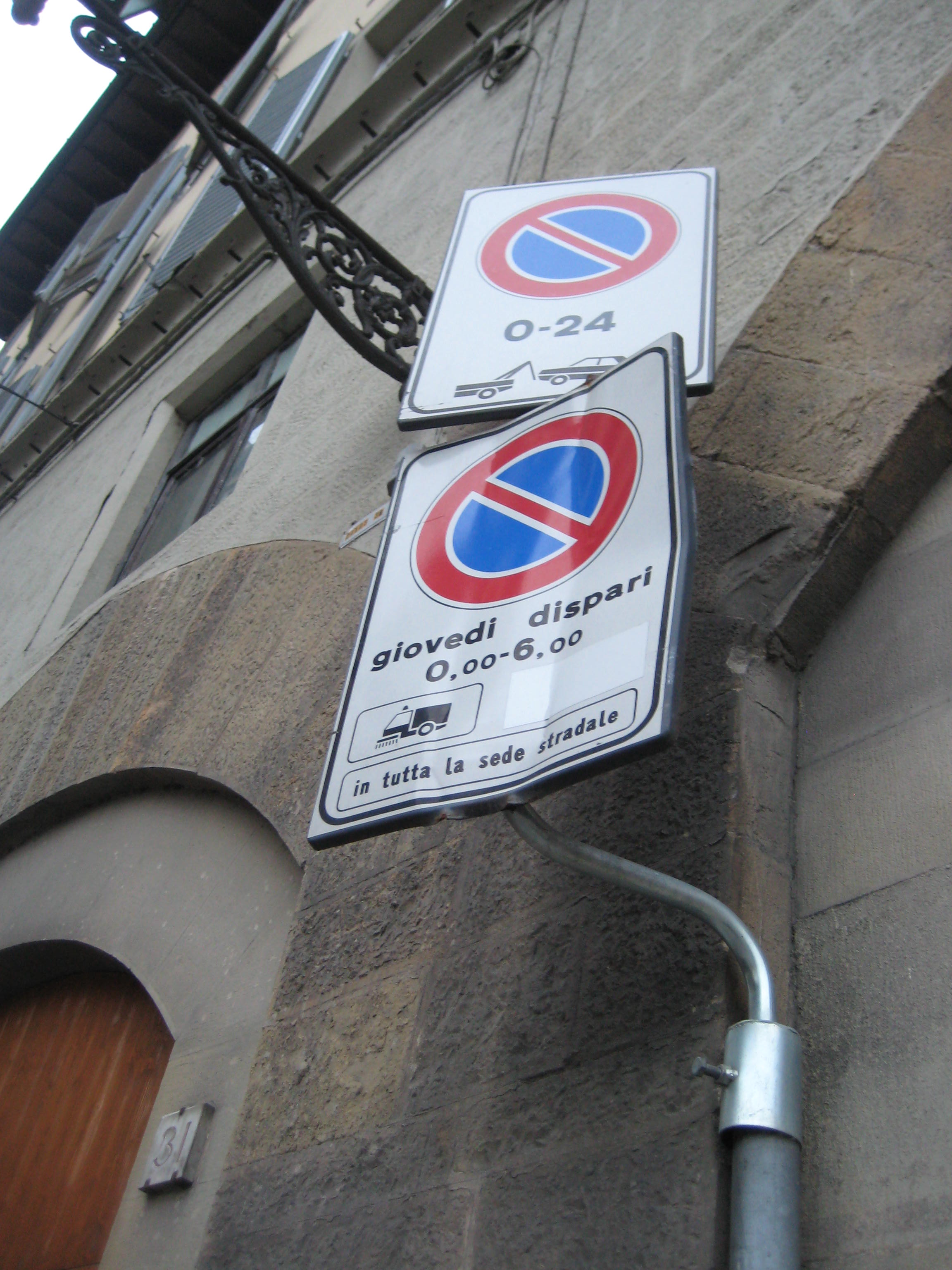
Parking signs in Florence
We got back from Napoli on Sunday, so I decided to spend Monday through Wednesday about town — regard the Uffizi’s Botticellis, meander through the Palazzo Pitti (I do love royal apartments and their gaudy tapestries), climb the Duomo, and do some window shopping in the little streets. Of course, visiting any museum in Florence requires a bit of planning and research, just like parking. Here’s what my guidebook says, and heavily qualifies, about museum hours:
“Nearly all of Florence’s major museums are closed on Monday, though some are open for a couple of Mondays each month. In the majority of cases, museum ticket offices close thirty minutes before the museum itself. At the Palazzo Vecchio and Museo Stibbert, however, it’s one hour before, while at the Uffizi, Bargello, Museo dell’Opera del Duomo, the dome of the Duomo, the Campanile and Pitti museums it’s 45 minutes.”
Needless to say, this left me little to go on (the fault of Italy, not the Rough Guide, by the way). It turns out, every museum on my list was closed on the first and last Mondays of every month, and the line to the Duomo was monstrous and in the very very cold shade.
So I chanced a walk to the Museo Galileo – formerly the Institute for the Study of the History of Science – which sits on the north side of the Arno River, between the Ponte Vecchio and the Ponte alle Grazie at Piazza dei Giudici 1.
Well-chosen. The Museo Galileo is open on Mondays and on all other days a week but (of course there is a but) note that it closes at 1pm on Tuesdays. It’s a science geek’s paradise that caters to the mystic in each of us too. The institute is the steward of the Medici and Hapsburg-Lorraine science collections, which include hundreds of meticulously wrought gold astrolabes, terrestrial globes, celestial globes, tools of geometry, tools to find the speed of an object is flight, and, if you climb up to the second floor, a particularly eery and accurate collection of some 30 models of fetuses in utero and in the process of birth, dating from the 18th century.
The early astronomical tools and maps were my favorites, a cross between mythic art and scientific exploration, when man gave life to the stars and the stars in turn guided man physically and narratively.
I was particularly taken by Santucci’s armillary sphere, constructed in the late 1500’s, and strikingly similar to the way I conceived of gravity last time I got stoned. Here’s a clandestine picture I snapped, but to learn more about it, or see some nice pictures, check out the museum’s virtual tour here: http://catalogue.museogalileo.it/room/RoomsIIIV.html.
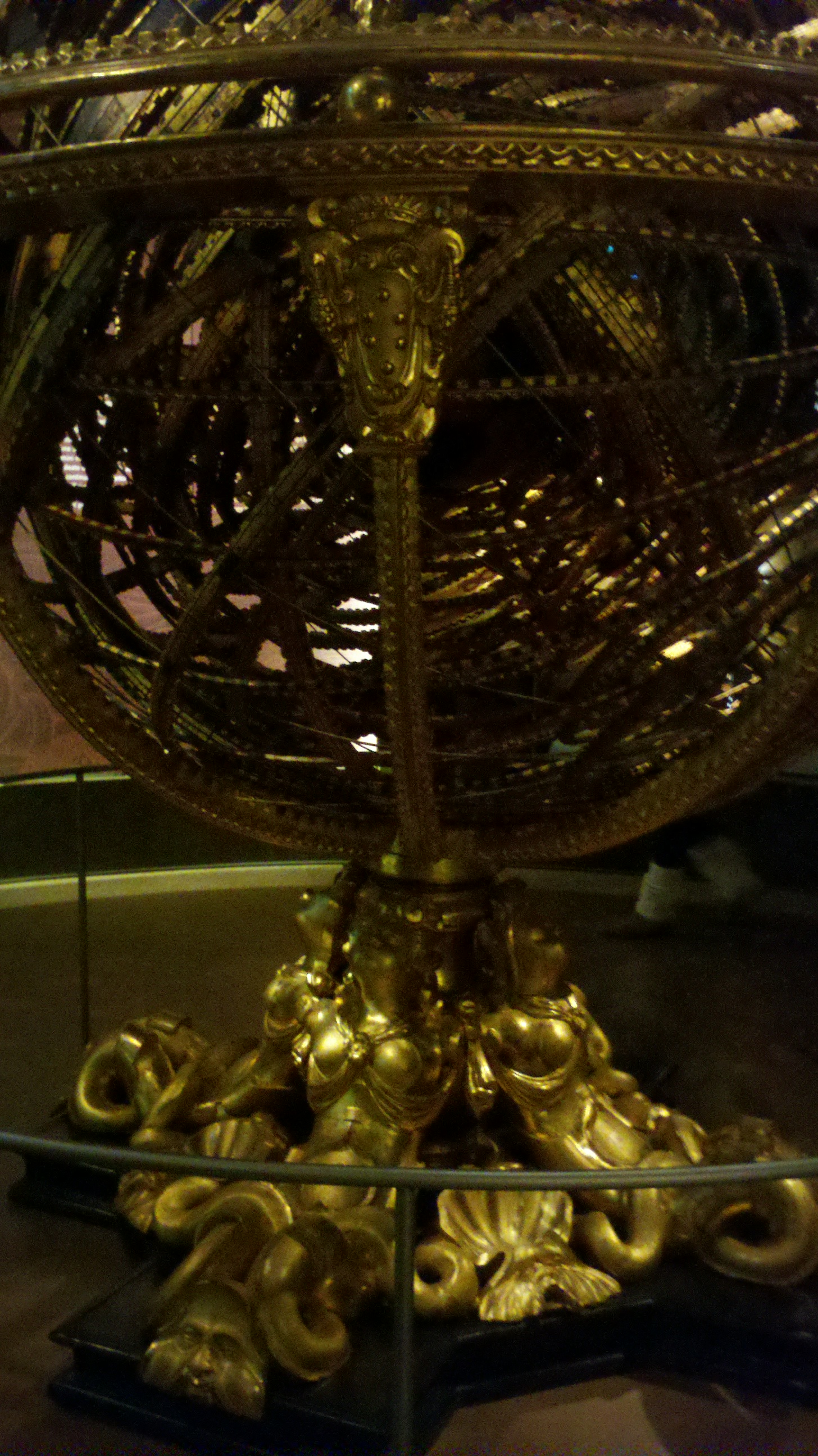
Armillary sphere, Museo Galileo
Afterward, grab lunch at the nearby Libreria BRAC, a reasonably priced and tasty vegetarian and vegan restaurant at Via de Vagellai 18r. You can read artsy books while you wait for your food which, because you are in Italy, will take awhile.